

Continuous Oxygen Stress in the Estuary of the Alexander Stream
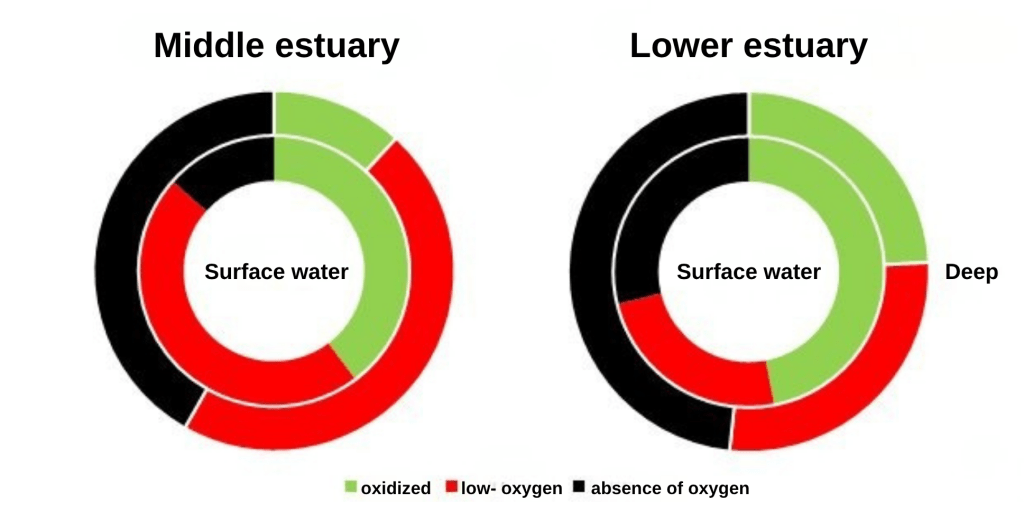
At the meeting point of streams and coastal rivers with the sea, salty, dense seawater penetrates upstream along the streambed. At the same time, fresher and less dense stream water flows above it in the opposite direction. This meeting zone is called an “estuary.” Estuaries are characterized by extreme spatial variability in their properties, and sometimes also temporal variability (such as salinity, temperature, and oxygen concentration), and therefore contain a wide variety of habitats within a relatively small area. Estuaries have significant environmental importance as areas of sedimentation and biological filtration of stream water, as nursery grounds for juvenile fish, and as recreation and leisure sites for people. As part of the research in the Alexander stream estuary, monthly sampling is conducted from the upper part of the estuary to its outlet to the sea, measuring profiles of chemical, physical, and biological parameters. In addition, two permanent monitoring stations equipped with data-logging sensors for temperature, oxygen, salinity, and depth have been installed in the estuary. Findings from six consecutive years of research show that the deep water in the estuary suffers from low-oxygen conditions 76–88 percent of the time, and the surface water is under such conditions 53–60 percent of the time. In addition, the Alexander stream estuary suffers from sustained periods of complete absence of oxygen.
The oxygen deficiency is caused by vertical stratification in the estuary’s water, combined with eutrophication (originating mainly from Palestinian Authority wastewater) that leads to the development of exceptional quantities of phytoplankton in the estuary’s water, which limits light penetration into the deep water. Our findings also demonstrate that the quantity of nutrients discharged into the estuary is more important than water quality. Even discharges of relatively high-quality effluent (treated at an improved secondary level) led to the development of poor water quality in the estuary, compared to a small discharge of poor-quality effluent (treated only at the primary level) which led to the development of high water quality in the estuary.