

The research team has compiled a booklet of insights and conclusions from a multi-year study in the Alexander and Taninim streams
The full booklet is available here (in Hebrew)
In the lower reaches of Israel’s coastal streams, water bodies known as estuaries are formed, where stream water meets sea water.
Estuaries are characterized by a wide range of conditions between marine and stream conditions, and therefore healthy estuaries contain a wide variety of habitats supporting rich ecological systems that provide diverse ecosystem services and are home to many animal species across a short geographic range.
The location of Israel’s estuaries at the heart of the coastal plain’s population centers makes them important providers of ecosystem services, both ecologically and as recreation and leisure sites.
In the past, it was not customary to relate to the estuarine characteristics of Israel’s coastal streams. However, a multi-year study conducted in the Alexander and Taninim streams, along with measurements in other coastal streams, showed that seawater penetrates far inland, so that long segments in the lowland part of the streams effectively constitute an estuary.
The results of the multi-year study show that the Alexander estuary is largely characterized by oxygen deficiency caused by effluent discharge into the stream. However, during periods of the study when no effluent flowed into the stream, a rapid recovery capacity of the estuary was observed, to the point of ecological flourishing without any further management intervention. Along the Israeli coast, 13 streams flow into the sea, and in many of them an estuarine zone exists near the outlet. The purpose of this booklet is to present the processes characterizing the Alexander estuary as a model for additional coastal streams, and to propose approaches for characterizing, monitoring, and managing these systems in a way that supports their natural recovery potential, until the development of a stable, rich, and sustainable ecological system that provides a variety of ecological services and serves as a focal point for recreation and leisure.
Main conclusions of the study:
► An estuary is not a stream! It is a unique ecological system, especially rich and diverse
► Estuaries have unique characteristics that require a tailored monitoring and management framework
► Estuary waters are characterized by long residence times, making them more sensitive to pollutant loads than to their concentration in the inflowing water
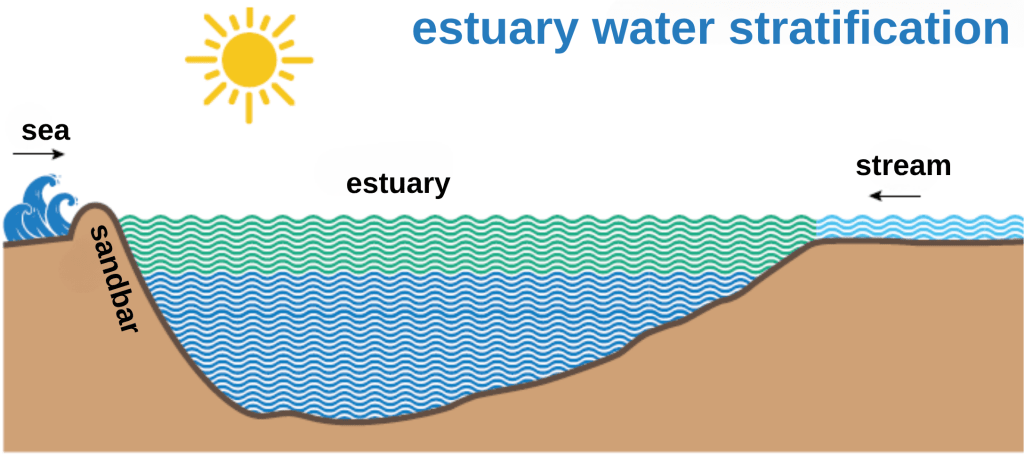
► Estuaries are characterized by an upper layer of fresh water and deeper, saltier water. These conditions lead to the formation of oxygen deficiency
► Continuous pollution, even at relatively low levels, is more harmful than short-term pollution
► First recommendation: effluent should not be discharged into natural water bodies
► Second recommendation: an engineering solution for emergency flood-release should be part of the watershed’s management toolkit